
The five places handwashing misses, and how to fix them
- 12 October 2026
- Neil Clarke
Thumbs, fingertips, between the fingers, the backs of the hands and the wrists. These are the five places handwashing most often misses, and almost nobody knows they are missing them.
Everyone thinks they wash their hands well
Ask a room of nurses, carers or chefs whether they wash their hands properly and almost every hand goes up. Most of them are right about how often they wash. Far fewer are right about how well.
The gap is not about effort or attitude. It is about what people cannot see. Soap and water leave no trace of where they have been, so a wash that misses the thumbs feels exactly the same as one that does not.
The research on this goes back almost fifty years, and it keeps finding the same thing: the same few areas are missed, by the same kinds of people, in the same ways. The good news is that once people see their own gaps, the gaps start to close.
The five spots everyone misses
A 1978 study of health professionals' handwashing by Taylor produced the map of missed areas that is still used in hand hygiene training. Later studies using UV tracer under lamps have found the same pattern again and again: fingertips and thumbs top the list, followed by the backs of the hands.
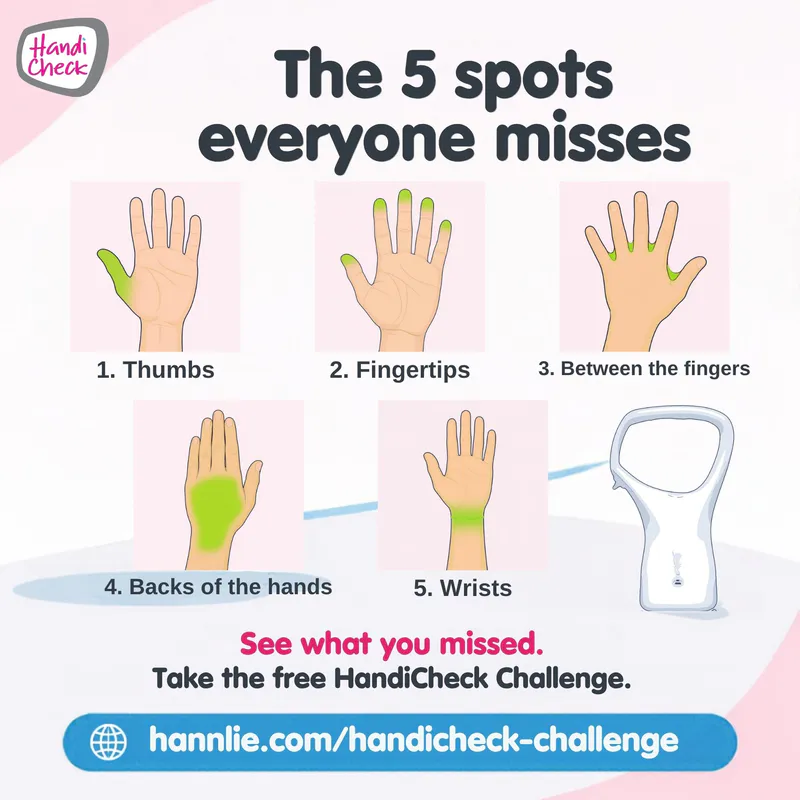
- Thumbs. Most people rub palm to palm and never wrap a hand around each thumb. The thumb sits slightly apart from the rest of the hand, so it simply gets left out.
- Fingertips. The tips and the skin under the nails do the most touching and get the least scrubbing. Unless you rub them into the opposite palm, soap barely reaches them.
- Between the fingers. A quick wash keeps the fingers together. The webbing between them only gets cleaned if the fingers are interlaced on purpose.
- Backs of the hands. The palms do the work, so the palms get the attention. In a 2024 hospital study using UV tracer, the back of the right hand had the lowest coverage of any surface, both before and after training (D'Agostino et al., 2024).
- Wrists. Sleeves, watches and a rush to the towel mean the wrists are often skipped altogether.
None of these are hard to clean. They are just easy to miss, and nobody can see that they have missed them.
Why posters and training are not enough
Most workplaces already tell staff how to wash their hands. There is a poster above the sink, a module at induction and a refresher once a year. The steps are right, but knowing the steps and doing them every time are two different things.
The same 2024 study shows the size of the gap. Before training, only 16.9% of 213 hospital staff covered at least 95% of every hand surface with a UV tracer rub. After a training programme, that rose to 48.7% (D'Agostino et al., 2024). These were trained professionals, and most still missed something before they could see it.
There are three reasons telling people is not enough:
- Nothing shows the mistake. A missed thumb looks and feels clean, so there is nothing to correct.
- Habits beat knowledge. On a busy shift people wash the way they always have, not the way the poster says.
- Audits watch, they do not show. Observing someone at the sink tells you whether they washed, not where the soap reached.
Seeing is believing: how HandiCheck works
HandiCheck makes the invisible part of handwashing visible, at the sink, in seconds. It has two parts.
- HandiSoap is a liquid hand wash with a UV tracer in it. It washes like normal soap, but wherever it has not been rinsed off properly, or never reached, the tracer stays on the skin.
- The HandiCheck unit is a compact UV hand checker, about 25cm tall, that sits beside the sink. You place one hand at a time inside the ring and the UV light shows any area the wash missed, glowing on the skin.
A check takes around ten seconds per person. There are no forms, no swabs and no waiting for results. The person washing sees exactly what they missed, on their own hand, and can wash again there and then.
That moment matters more than any instruction. People remember what they have seen on their own hands far longer than what they were told in a training room, and the next time they wash, they wrap a hand round each thumb.
What it means where you work
Hospitals and infection prevention teams. The WHO estimates that at least 7 in every 100 hospital patients in high income countries pick up an infection while being treated, and that health workers' hands are a main route for spreading it (WHO). HandiCheck gives IPC teams a ready made activity for ward visits, induction and awareness weeks such as International Infection Prevention Week, held every third week of October (ISID). HandiCheck for healthcare
Care homes and care groups. Carers move between residents all day, often with little time between tasks. A HandiCheck by the staff sink shows staff, inspectors and families that hand hygiene is checked, not assumed, and gives managers something visible to talk about in supervision. HandiCheck for care homes
Food production and kitchens. The Food Standards Agency tells food handlers to rub the palms, the backs of the hands, between the fingers and around the thumbs and fingertips, and says gloves are never a substitute for handwashing (FSA Safer food, better business). That list matches the five spots most often missed almost word for word. HandiCheck gives proof at the sink before the shift starts. HandiCheck for food preparation
Take the HandiCheck Challenge
The quickest way to find your team's gaps is to see them. The HandiCheck Challenge brings everything to your workplace, free and with no obligation.
- We come to you. We bring the HandiCheck unit and a portable sink, so there is nothing to plumb in.
- Wash as normal. Your team wash with HandiSoap, exactly as they would on shift.
- See the result. One hand at a time under the UV lamp shows every area that was missed.
- Talk it through. If your team finds it useful, we leave a unit with you on a free trial.
The Challenge and the trial unit are free. If you keep using HandiCheck, the only ongoing cost is HandiSoap, at a couple of pence a wash. We visit across the South West and in London and the Home Counties, and further afield by arrangement.
Book your HandiCheck Challenge or call 07396 909894.
Questions people ask
Which parts of the hand are most often missed when washing?
The thumbs, fingertips, the skin between the fingers, the backs of the hands and the wrists. Fingertips and thumbs are missed most often.
How can you check whether hands have been washed properly?
Wash with a soap containing a UV tracer, such as HandiSoap, then hold each hand under a UV light. Any area the wash missed glows, so it can be washed again straight away.
What is a UV hand hygiene checker?
A device with an ultraviolet light that shows where tracer soap or gel is left on the skin. HandiCheck is a compact unit, about 25cm tall, that sits beside the sink and checks one hand at a time.
Does UV hand checking replace hand hygiene training?
No. It makes training stick. Staff see their own results, so they know exactly which areas to work on.
How long does a HandiCheck take?
Around ten seconds per person, at the sink, with no swabs or lab results.
Do we need a sink to take the HandiCheck Challenge?
No. We bring a portable sink, so any room near a plug socket works.
How much does it cost?
The Challenge and the trial unit are free. If you keep using HandiCheck, you only pay for HandiSoap, at a couple of pence a wash.
Sources
- D'Agostino F. et al. (2024), Evaluation of a training program on hand hygiene for healthcare workers, Le Infezioni in Medicina 32(4)
- World Health Organization (2014), Good hand hygiene by health workers protects patients from drug resistant infections
- Food Standards Agency, Safer food, better business: hand washing
- ISID, International Infection Prevention Week
- Taylor L.J. (1978), an evaluation of handwashing techniques by health professionals, summarised here